
Traditional pottery in Anatolia is divided into two groups according to production quality and the social classes they served: high-quality production centers and folk-style pottery centers.
In Çatalhöyük and Hacılar, the settlement centers of the Late Neolithic and Chalcolithic periods in Anatolia, pottery production is known to date back to around 5000 BCE. The Hittite Civilization and Mesopotamia constituted rich foundations for the development of ceramic art in Anatolia. The use of the potter’s wheel, which began in the eastern and southeastern regions of Anatolia, first appeared in the Aegean Region together with Troy. In excavations in Smyrna, Klazomenai, Phocaea, and Samos dating to around 1200 BCE, terracotta finds have been recovered, including examples with geometric patterns. Phrygians and Lydians developed their own unique methods of decorating earthenware. It is suggested that the amphora tradition used for transporting wine and oil continues today in Menemen pottery.
Various excavations have yielded important ceramic findings from the Roman and Byzantine periods. The sgraffito decorations, colored glaze applications, and figural compositions found in Byzantine ceramics formed a smooth transition to Seljuk and Ottoman ceramics. During the Seljuk period, Iranian ceramics influenced Anatolia, and artists were brought from Iran. Over time, this influence led to the development of an original style that left a mark on ceramic history through Anatolian Seljuk and Ottoman works.
During the 13th-century Seljuk era, works were produced using underglaze, luster, minai, and slip painting techniques. Glazed tiles, glazed bricks, and mosaic brick applications are observed. Turquoise, aubergine purple, and near-black colors stand out. Designs applying these colors often feature repetitive decorations based on the principle of infinity. In the tile examples of Kubadabad Palace, Kayseri Keykubadiye Palace, Diyarbakır Artuqid Palace, and Konya Alaeddin Palace, numerous stylized figural compositions are encountered. The Seljuks, when they arrived in Anatolia, brought Central Asian and Islamic art traditions with them, and also absorbed influences from the existing Byzantine ceramics, bringing a fresh artistic spirit to ceramic art.
In ceramics of the 14th-century Beylik (Principalities) Period, a simplification is observed compared to the Seljuks. New production centers emerged: Iznik and Kütahya. While Iznik produced more for the palace, Kütahya created works for the general public. Turquoise, purple, green, and navy blue dominated the Beylik and Early Ottoman periods.
Chinese Ming dynasty blue-and-white porcelains of the 15th century influenced Ottoman tile art. Iznik developed lower-temperature examples of these porcelains, creating an entirely new group of works—blue-and-white Ottoman ceramics. In the Aegean Region, during the second half of the 14th century to the late 15th century, ceramics featuring abstract floral patterns in dark blue tones are known as “Miletus Ware.” However, these examples have been proven to be produced in Iznik.
Iznik became one of the major tile-making centers of the Ottoman Empire. Tile production, which began in the early 15th century, developed rapidly and the city earned the name “Iznik the Tiled.” Evliya Çelebi, who visited Iznik in the 17th century, recorded that the people of nine neighborhoods made a living by producing tiles and pottery, and that there were 340 tile kilns in the city. Coral red, which emerged after 1557, added exceptional beauty to the tiles. Even in the early 17th century, highly successful tiles continued to be produced. The Sultan Ahmed Mosque, Topkapı Palace’s Revan and Baghdad Pavilions, and the façade around the entrance of the Circumcision Room are decorated with tiles from this period. Over time, however, architectural activity declined due to financial constraints, and Iznik tile production deteriorated. Workshops without commissions gradually closed, and by 1716, tile production in Iznik came to a complete end.
The peak of tile art in the 16th century can be traced to the Palace Design Studio (Saray Nakkaşhanesi). Tile production of this period was not folk art but a state-supported industry. During the reign of Süleyman the Magnificent, within the Ottoman court artists’ guild called Ehl-i Hiref, there was a group of tile makers known as the Kaşigeran division. After the 17th century, as palace patronage declined, tile art regressed and Kütahya—producing folk-style ceramics—rose to prominence.
From the 15th century onward, Iznik ceramics experienced a technological transformation that secured their fame: a shift from clay-based to quartz-based (hard, white-bodied) ceramic paste. These ceramics, which gained a soft-porcelain character, began to replace Chinese porcelains, especially with their blue-and-white decorations.
In Europe, where porcelain production had not yet begun, Iznik ceramics became valuable import goods and were used as wall decorations. Commissioned pieces bearing the coats of arms of Europe’s noble families appear in various collections, and kiln waste fragments have also been discovered during excavations in Iznik. Iznik ceramics became fashionable in the Near East, Egypt, Mediterranean islands, and Western Europe, with large-scale exports carried out.
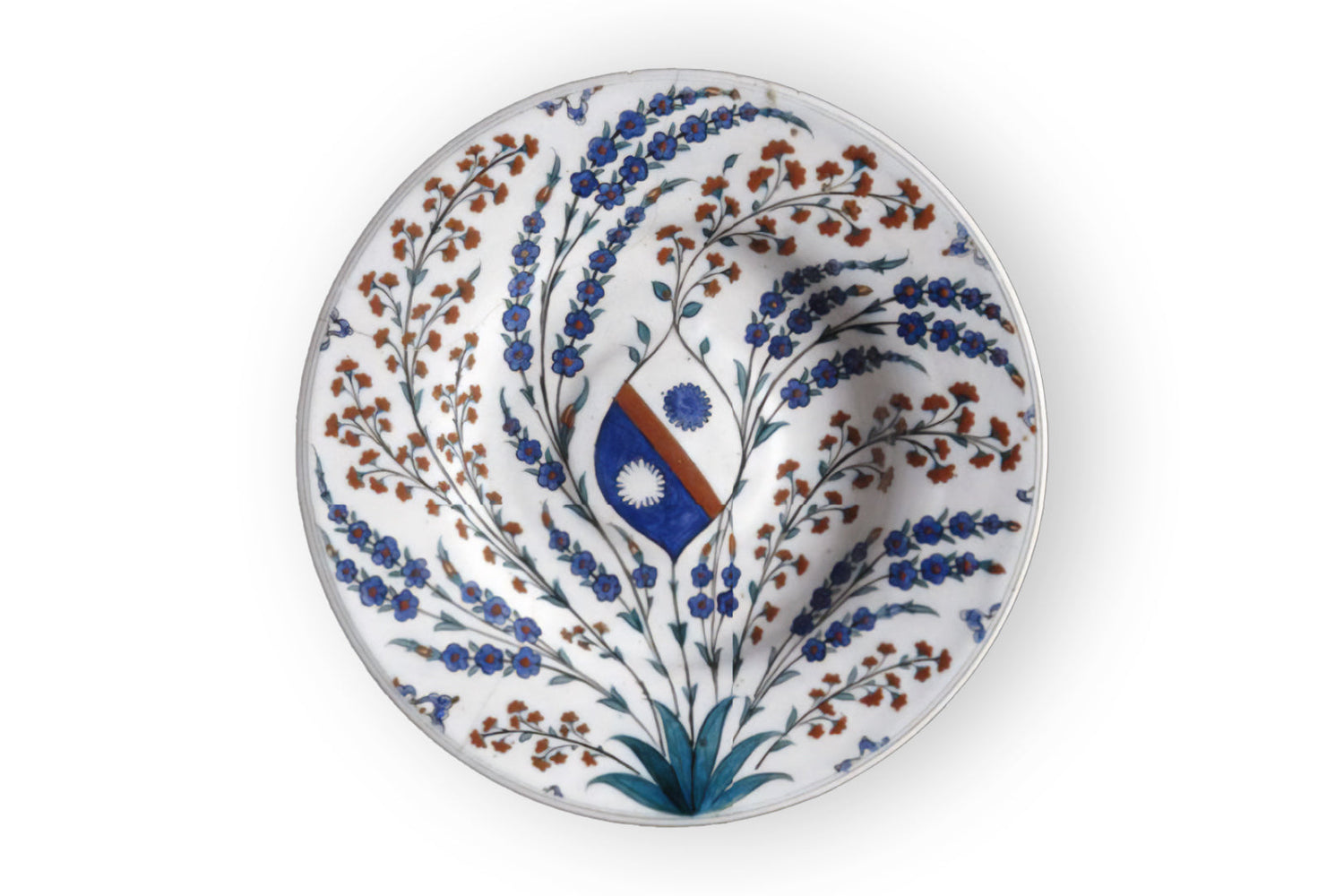
The coat of arms on the Iznik ceramic plate below is not conclusively identified, but it is believed to belong to a member of the Spingarolli de Dessa family of Dalmatia (Northern Yugoslavia). The most striking feature of these dining plates is that each one has a different decorative arrangement. Although the central coat of arms remains the same, the surrounding floral compositions vary in design. These variations can clearly be seen in examples from the Ashmolean Museum and the British Museum collections. According to archival records, a total of nine plates from this series have been identified in Europe. The plate in the photograph was unearthed during excavations in the Iznik tile kilns and has been recorded as the 10th plate of the series. This special piece was exhibited for the first time in 2025 at the Iznik Museum.
Iznik tilemaking, which experienced its brightest era between the 15th and 17th centuries, declined by the late 17th century with the early signs of the Industrial Revolution in the West and the state’s withdrawal of support for such investments. The industry stagnated and eventually faded in the 18th century. During this period, the more economical and everyday-product-oriented workshops of Kütahya emerged.
Ceramics in Kütahya and its surroundings, which began with the Phrygians, continued to develop up until the end of the Byzantine era. For more than 100 years, Kütahya remained a transitional region between the Seljuks and Byzantines. Ceramic production here combined elements of both Byzantine and Seljuk art. After entering the Beylik period, the Ottoman influence became evident in Kütahya.
While Iznik workshops advanced with palace support and white-bodied production, Kütahya served as a secondary center that supported Iznik when needed and maintained its existence through production aimed at everyday use.
In the 18th century during the reign of Ahmed III, Grand Vizier Nevşehirli Damat İbrahim Pasha attempted to revive tilemaking by establishing a workshop in Istanbul’s Tekfur Palace, bringing materials and masters from Iznik. The works produced, notable for their gray-greenish glazes, never achieved the former level of quality.
From the late 17th century to the mid-20th century, Çanakkale emerged as an important ceramic production center. The exact beginning of pottery in Çanakkale remains unknown. Plates, deep bowls, jars, ewers, pitchers, and vases were frequently produced. The sailboat and galleon motifs reflect the region’s connection to the sea.
In short, the presence of terracotta materials in the earliest Anatolian civilizations has been confirmed through archaeological excavations. Numerous centers existed throughout Hittite, Ancient Greek, Byzantine, and later Great Seljuk, Anatolian Seljuk, and Beylik periods in which ceramics were produced and used. Chinese blue-and-white products that arrived via the Silk Road entered Anatolia during the Ottoman Empire, leading to the emergence of Iznik works that used local clay yet resembled Chinese porcelain examples. Later, Kütahya and Çanakkale became prominent centers. In the late Ottoman period, European-influenced designs entered Turkish ceramic art beginning from the reign of Abdulhamid II and increased thereafter. (“Turkish Ceramic Art in the 20th Century,” Gül Erbay Aslıtürk, pp. 65–71).


